6G network, from tracking algorithms to reflective surfaces:
What the European TIMES project studies for wireless in industry
- Research institutions and companies from five countries collaborate on the EU-co-funded project to develop THz frequency networks with simultaneous and reliable performance at cable levels
- After acquiring theoretical knowledge on the channels, the "proofs of concept" come to life to test the effectiveness of technologies for a new telecommunications paradigm
- The team of experts directly designed and fabricated the enabling components such as integrated circuits, modems, antennas, smart mesh networks, reflective surfaces and much more
- Co-financed by the EU (budget 6 million €), the TIMES project has a duration of three years and is promoted by SNS-JU, a partnership that aims to facilitate European leadership in 5G-6G.
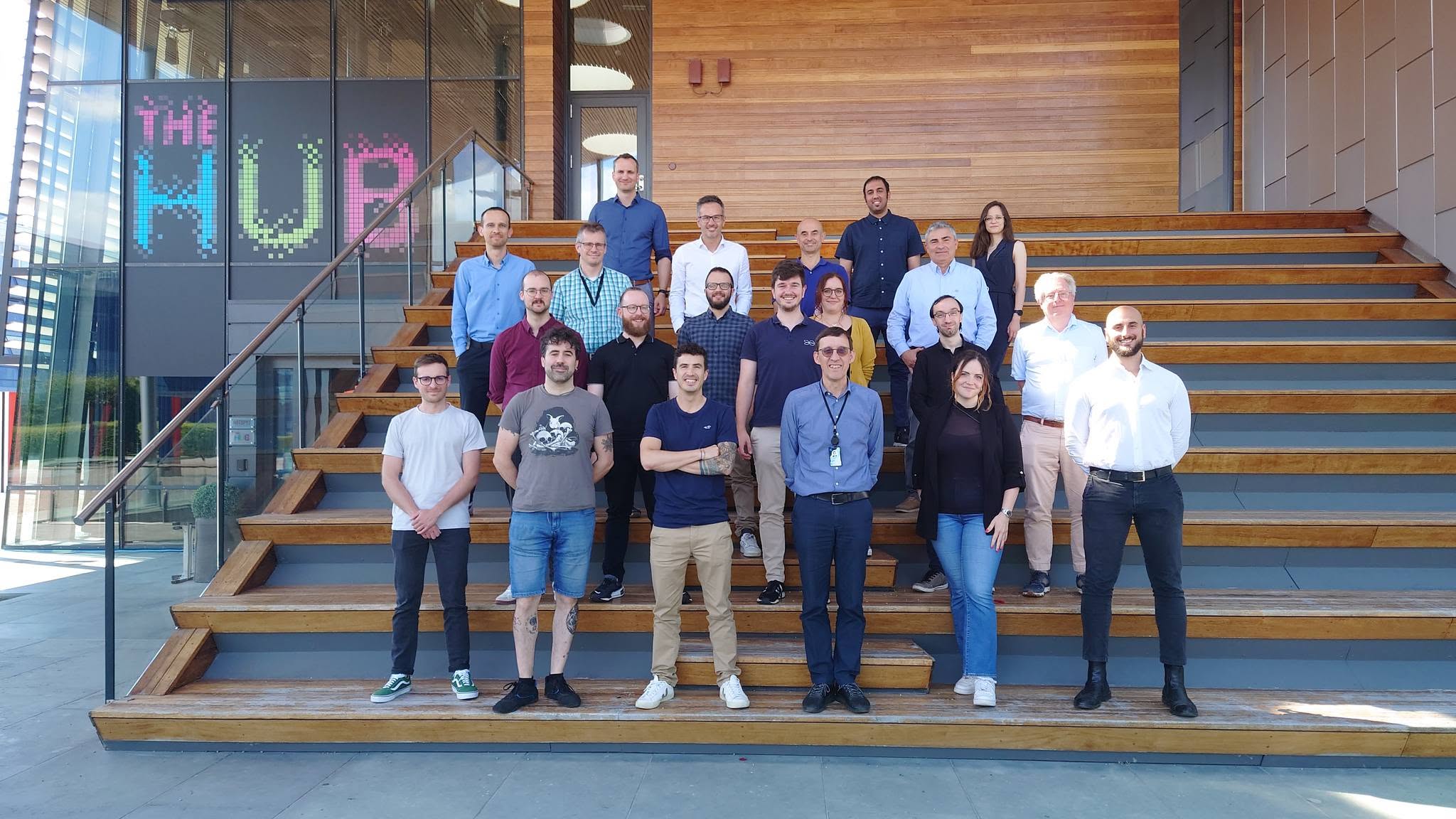
Photo from the third Face-to-Face Consortium Meeting held in Oslo
Among feasibility tests, evidence collection, and the creation of innovative devices, the European TIMES project progresses with new laboratory results thanks to the collaboration of 10 partners from five countries of the initiative, coordinated by Cnit - Consorzio Nazionale Interuniversitario per le Telecomunicazioni (IT) and co-financed by the EU under the Horizon Europe call, which aims to develop solutions for wireless communication on 6G networks in the industrial field, capable of guaranteeing performance comparable to wired networks.
The first applications will be tested from January, and the team of researchers is already working to implement the theoretical knowledge acquired through "Proof of Concept" (PoC), demonstration platforms to highlight the effectiveness of emerging technologies in the field of sixth-generation networks, thus paving the way for a future where high-speed, low-latency, and high-capacity wireless communications become the norm rather than the exception.
TIMES is working on three pillars of innovation: ultra-wide-band bandwidth, the implementation of intelligent mesh networks (networks where each device is directly and dynamically connected to other devices without predefined hierarchies), and the enabling of high-definition integrated sensing and communications.
Over the past year, TIMES has successfully extracted parameters from data collected during preliminary channel measurements to study their characteristics. This is a crucial step for the design and optimization of future wireless communication networks, based on TIMES' vision of a smart radio ecosystem operating at Terahertz (THz), capable of connecting numerous heterogeneous devices in industrial contexts, with reliability comparable to wired connections but without the inherent limitations.
These systems will need to support new applications within advanced scenarios, such as IoT sensing, cooperative robots, predictive maintenance, fast-moving vehicles, real-time closed-loop control, intra-machine communication, etc. The reference parameters concern data speed, ultra-low latency, millimeter-level localization precision, and reliability with a transmission error rate of one in a billion.
In this scenario, TIMES is developing the components that enable a new telecommunications paradigm. Theoretical work on radio planning, channel modeling, waveform design, and localization techniques for THz communications in industrial environments is fundamental. This focus will be complemented by the refinement of localization and tracking algorithms for human and non-human targets using standard radar.
Experts are ready to test the new FDD (Frequency Division Duplex) and TDD (Time Division Duplex) modems specifically designed to make them compatible with intelligent mesh networks (a network formed by a group of devices that function as a single network) and that can use specific equipment. At the same time, intermediate results have been achieved on the optimization of multi-objective mesh networks based on Thz, an important step towards the realization of high-capacity, low-latency communication networks.
Additionally, the fabrication of wafers with Thz front-end circuits, a key element for the realization of high-frequency communication devices, is almost complete. The design of fully integrated MMIC (broadband integrated circuits) front-end transmission and reception has been finalized, with projects registered at the end of 2023. These devices represent a key element for the realization of high-frequency communication systems.
The PoCs will demonstrate the advantages of the integrated sensing and communication paradigm in a single system, a new approach to wireless network design that can bring a range of benefits in terms of efficiency and flexibility, especially in a mobile sector-relevant environment. The effectiveness of innovative high-gain and beamsteering antenna models, essential for achieving high-capacity, low-latency 6G communications, is also under examination.
The first prototypes of Intelligent Reflective Surfaces (IRS) have been fabricated and tested in the laboratory, and preliminary results have been obtained on physical layer issues related to intelligent propagation environments, a largely unexplored field of research. These surfaces can be used to improve the coverage and performance of wireless networks, especially in non-line-of-sight regions, maintaining high performance, a key objective of the TIMES project that will be demonstrated in the appropriate PoCs.
The characterization of the THz channel with the IRS is among the main activities planned, as it will form the basis for the development of sophisticated channel models, a key element for the project's success at a crucial point in the journey. At the same time, innovative beam transfer procedures will be developed using permeable wave antennas, which radiate differently depending on the frequency. These procedures will be assisted by sensing information, an approach that promises to significantly improve system efficiency.
TIMES has a duration of three years, an estimated budget of six million euros, and sees the collaboration of the following partners among research institutions and companies, coordinated by the National Laboratory WiLab of the Consorzio Nazionale Interuniversitario per le Telecomunicazioni (CNIT): BI-REX Big Data Innovation & Research Excellence, Aetna Group Spa (Italy); CNRS - Centre National de la Recherce Scientifique (France); Anteral Sl (Spain); Fraunhofer Gesellschaft, Huawei Technologies Duesseldorf Gmbh, Technische Universitat Braunschweig, University of Stuttgart (Germany); Telenor Asa (Norway).
TIMES ("THz Industrial Mesh networks in Smart sensing & propagation environments") is part of the SNS-JU public-private partnership that aims to facilitate the development of European leadership in 5G and 6G networks and services. One of the key strategies to overcome emerging challenges during the project has been the collaboration with Terrameta, another Horizon project on 6G technologies, which has allowed leveraging complementary expertise, improving efficiency, and collaboration among partners. Adaptability, collaboration, and innovation are the keywords of the project, well-positioned to face future challenges and continue to make significant progress.