6G Network, From Research to Reality: TIMES Demonstrates Proof-of-Concept for THz Wireless in Industrial Environments
- The European project validates two Proof-of-Concepts in representative industrial environments, demonstrating the potential of Terahertz (THz) wireless communications.
- Real production scenarios were tested: from industrial packaging to digital factories, with applications on machines, robotics and control systems.
- The results pave the way for the integration of 6G technologies in manufacturing contexts, progressively replacing wired infrastructure.
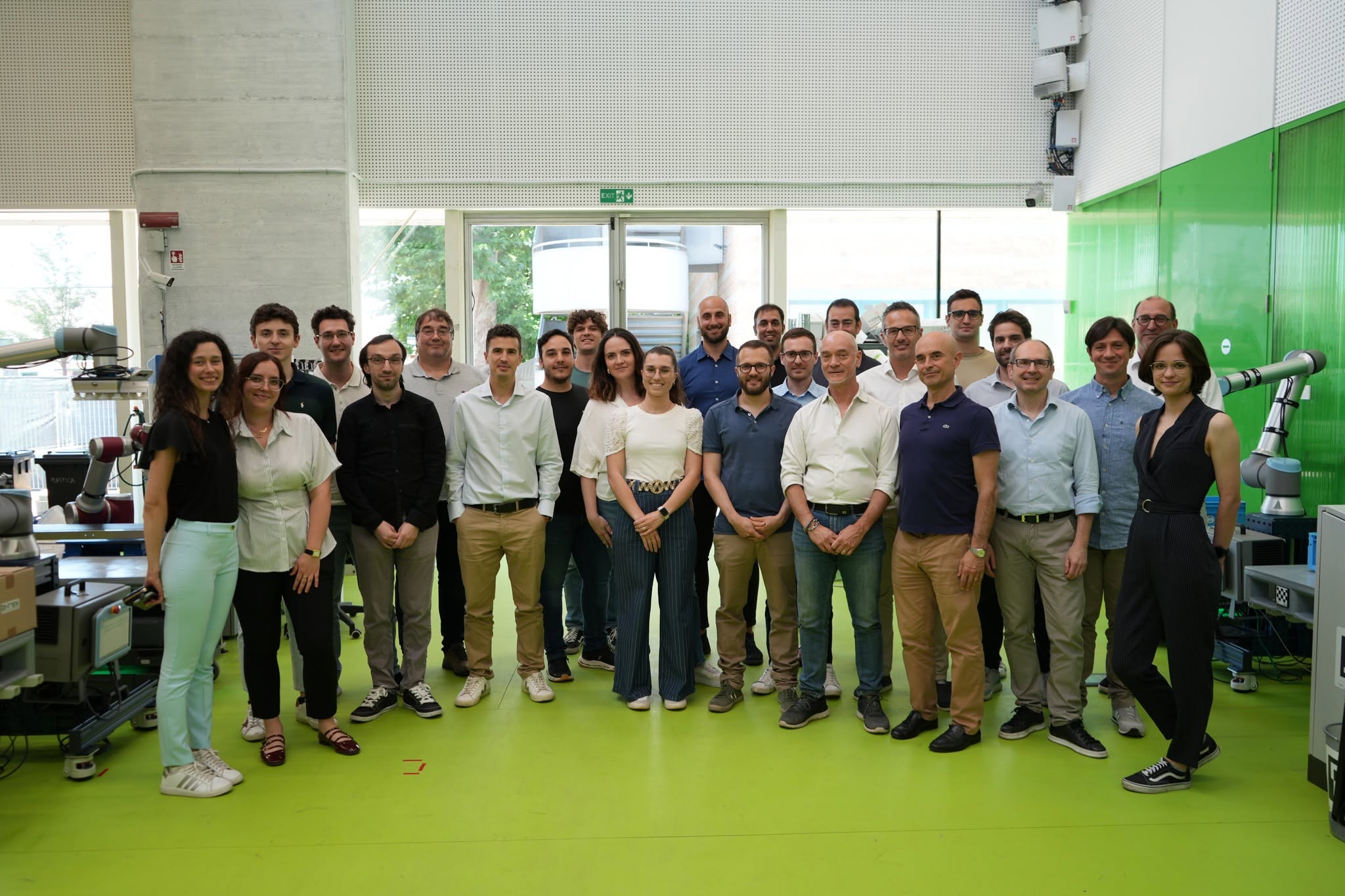
Photo from the third Face-to-Face Consortium Meeting held in Bologna
From research to reality: the European project TIMES takes a concrete step toward the adoption of 6G technologies in industrial scenarios, demonstrating through two Proofs-of-Concept (PoC) the applicability of Terahertz (THz) wireless communications in real production environments.
Co-funded by the European Union under Horizon Europe and promoted by the Smart Networks and Services Joint Undertaking (SNS JU), TIMES (“THz Industrial Mesh networks in Smart sensing & propagation environments”) aims to develop advanced wireless networks capable of connecting heterogeneous devices - machines, robots and sensors - ensuring high transmission capacity, ultra-low latency, precise localization and reliability comparable to wired connections.
Over the past three years, the project has focused on overcoming the limitations of current 5G networks by developing technologies capable of delivering significantly higher performance. TIMES solutions operate at much higher frequencies than existing wireless technologies, enabling greater bandwidth and more precise localization, key aspects for advanced industrial automation scenarios.
One of the main challenges addressed concerns the use of THz frequencies in industrial environments, where obstacles, reflections and dynamic configurations can affect signal propagation. Project activities included not only data transmission at these frequencies, but also integration of the technologies into existing industrial networks, with dynamic link management, coordination between nodes and support for high-density device scenarios.
A key element has been the use of mesh networks and the integration of communication with sensing and localization functionalities, essential for advanced applications in complex production environments. From a performance perspective, the activities demonstrated that the developed solutions can approach wired connection performance in terms of throughput and latency, while maintaining the typical advantages of wireless in terms of flexibility, reconfigurability and ease of deployment.
The trials confirmed the feasibility of THz communications in real industrial environments, characterized by physical constraints, interference and dynamic layouts.
The first PoC was carried out at the AETNA TechLab, in an industrial setting representative of automatic and semi-automatic packaging machines. Here, a wireless link configuration between fixed nodes was tested, with communication possible even in non-line-of-sight conditions, leveraging signal reflections on surrounding surfaces. This approach made it possible to verify the stability and high performance of THz links in complex environments.
The second PoC took place in the digital factory environment of Technische Universität Braunschweig (TUBS), with BI-REX validation, representing future smart factories. Here, a mobile node communicating with a fixed infrastructure was introduced, simulating dynamic scenarios relevant to mobile robotics and flexible production systems. This test highlighted challenges related to mobility, link alignment and radio channel variability at THz frequencies.
Overall, the activities included not only ultra-high-capacity, low-latency data transmission, but also the integration of technologies into industrial network architectures, with link management, adaptation to environmental conditions, and support for heterogeneous device scenarios. The results show that while fixed links already offer reliable performance, mobility scenarios remain an open research frontier, confirming both the potential of THz technologies and the challenges toward full industrial maturity. The PoCs demonstrate the possibility of bringing wireless performance closer to that of wired systems, while maintaining advantages in flexibility and reconfigurability.
“These results mark an important step in the development of 6G networks, in which THz communications will play a key role in enabling ultra-high-performance wireless connectivity -comments Francesco Meoni, CTO di BI-REX - TIMES has helped bridge the gap between research and real industrial application, supporting the transition toward more flexible, efficient and fully interconnected production environments.”
The TIMES project involves ten partners among research institutions and companies from five European countries, coordinated by CNIT – National Inter-University Consortium for Telecommunications (Italy). Partners include Aetna Group Spa (Italy), Anteral SL (Spain), BI-REX Big Data Innovation & Research Excellence (Italy), CNRS – Centre National de la Recherche Scientifique (France), Fraunhofer Gesellschaft (Germany), Huawei Technologies Düsseldorf GmbH (Germany), Technische Universität Braunschweig (Germany), Telenor ASA (Norway) and the University of Stuttgart (Germany).